Pearson Edexcel · A-Level · Economics B
Course version: 9EB0 · Version from Sept 2015
Quantitative skills: QS 1: calculate, use and understand ratios and…
Full specification wording
Appendix 3: Quantitative skills: QS 1: calculate, use and understand ratios and fractions
Ratios and fractions are fundamental quantitative skills in economics, used to express the relationship between two or more quantities.
Checked against the Pearson Edexcel 9EB0 specification (opens in a new tab) on .
- Point 1 of 7
- 3 key terms
Study notes
From the checked teaching notes for this specification point.
The idea
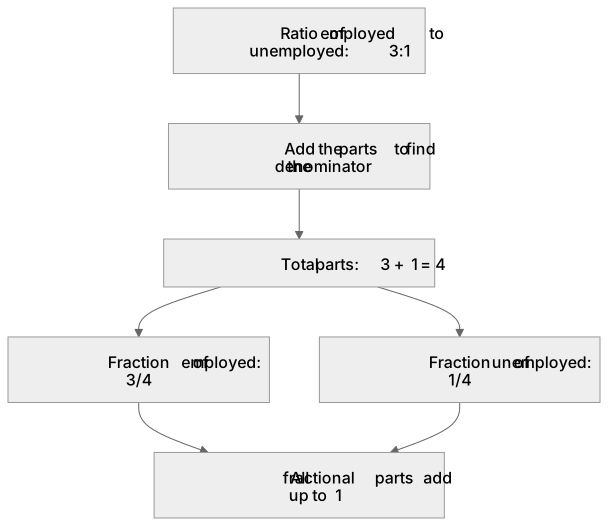
Ratios and fractions are fundamental quantitative skills in economics, used to express the relationship between two or more quantities. A ratio compares parts to parts or parts to a whole, such as a 3:1 ratio of employed to unemployed individuals in a specific sample. To calculate a fraction from a ratio, add the parts together to find the denominator; in a 3:1 ratio, the total is 4, so the fraction of employed individuals is 3/4. Understanding these concepts allows economists to analyse market shares, concentration ratios, and financial performance. You must be able to calculate these figures from raw data, use them to interpret economic scenarios, and understand their implications for business strategy and economic policy.
What earns the marks
- Accurately calculate a ratio by dividing two quantities by their greatest common divisor to express it in its simplest form.
- Convert a ratio into a fraction by summing the components of the ratio to determine the denominator.
- Use fractions to calculate a proportion of a total economic value, such as determining a firm's market share from total market sales.
- Interpret the economic meaning of a calculated ratio or fraction within the context of the provided data, such as assessing market concentration.
Common mistakes and how to put them right
Confusing the denominator when converting a ratio to a fraction.
Put it right: Sum all parts of the ratio to find the correct denominator for the fraction.
Failing to simplify ratios to their lowest terms.
Put it right: Divide both sides of the ratio by their highest common factor unless the question specifies otherwise.
Misinterpreting a part-to-part ratio as a part-to-whole fraction.
Put it right: Recognise that a 1:4 ratio means 1 part out of 5 total parts, not 1/4.
Exam tips
- Always check if the question asks for the answer in its simplest form or as a specific ratio format, such as n:1.
- When calculating concentration ratios, ensure you are summing the market shares of the correct number of top firms as specified in the data.
- Use fractions to double-check your ratio calculations by ensuring all fractional parts add up to exactly 1.
Try the lesson
The start of the Appendix 3: Quantitative skills: QS 1: calculate, use and understand ratios and fractions lesson, made from checked teaching notes for this specification point.
Have a go first
A manufacturing business employs 45 production staff and 15 administrative staff. What is the ratio of administrative staff to production staff expressed in its simplest form?
Listen
Ratios and fractions are fundamental quantitative skills in economics, used to express the relationship between two or more quantities. A ratio compares parts to parts or parts to a whole, such as a 3:1 ratio of employed to unemployed individuals in a specific sample. To calculate a fraction from a ratio, add the parts together to find the denominator; in a 3:1 ratio, the total is 4, so the fraction of employed individuals is 3/4. Understanding these concepts allows economists to analyse market shares, concentration ratios, and financial performance. You must be able to calculate these figures from raw data, use them to interpret economic scenarios, and understand their implications for business strategy and economic policy. A strong answer earns marks for these points. Accurately calculate a ratio by dividing two quantities by their greatest common divisor to express it in its simplest form. Convert a ratio into a fraction by summing the components of the ratio to determine the denominator. Use fractions to calculate a proportion of a total economic value, such as determining a firm's market share from total market sales. Interpret the economic meaning of a calculated ratio or fraction within the context of the provided data, such as assessing market concentration. A common slip: Confusing the denominator when converting a ratio to a fraction. Instead, sum all parts of the ratio to find the correct denominator for the fraction. Exam tip: Always check if the question asks for the answer in its simplest form or as a specific ratio format, such as n:1.
See it
Key words
Say what each word means before you turn the card.
Ratio
Try answering aloud or in your head before turning the card.
Fraction
Try answering aloud or in your head before turning the card.
Market concentration
Try answering aloud or in your head before turning the card.
See every definition
- Ratio
- A comparison of parts to parts or parts to a whole, such as a 3:1 ratio of employed to unemployed individuals in a specific sample.
- Fraction
- A part-to-whole expression obtained from a ratio by summing the parts to find the denominator, so a 3:1 ratio gives 3/4.
- Market concentration
- An economic feature assessed by interpreting a calculated ratio or fraction within the context of the provided data.
Label the diagram
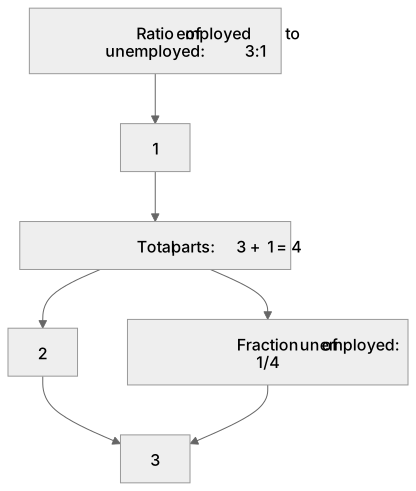
Some boxes have lost their names. Pick the right name for each number.
1Box 1
2Box 2
3Box 3
There is more to this lesson
The full lesson goes on to check your understanding and help you earn the marks. Create a free account to carry on, with your progress saved.
A week of Premium from your first lesson · Then the free plan continues · No card, no charge
Test your understanding of Appendix 3: Quantitative skills: QS 1: calculate, use and understand ratios and fractions
Active recall beats re-reading. Take an instant quiz now to test what you’ve learned and lock it into long-term memory.
A week of Premium from your first lesson · Then the free plan continues · No card, no charge